
Rotator Cuff Related Shoulder Pain (RCPRS) Explained
What is it?
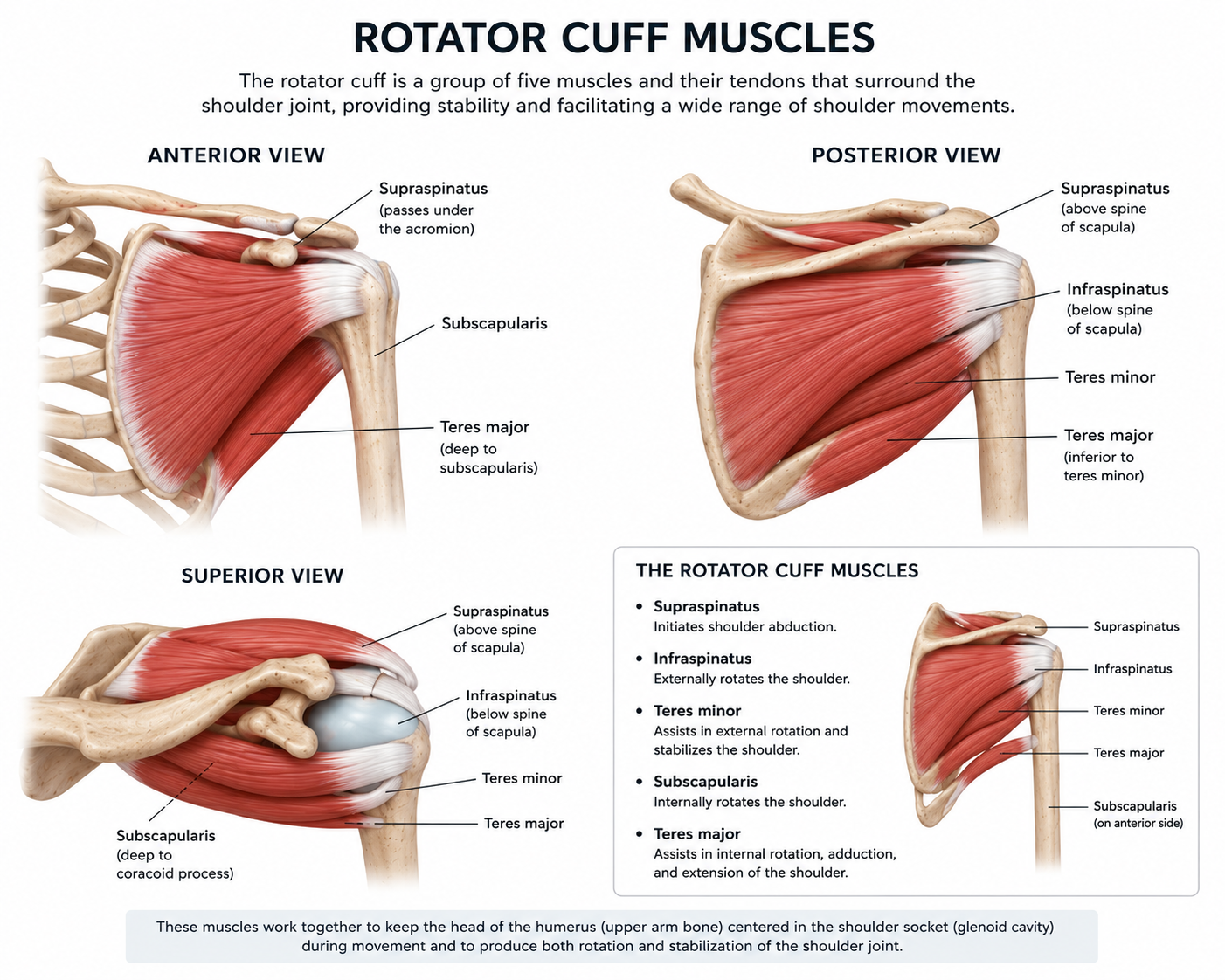
Your rotator cuff is a group of four small muscles and their tendons that sit around the ball of your shoulder. They keep the joint centred and help you lift, reach and rotate.
Rotator cuff related pain is the most common cause of shoulder pain. The tendons become irritated and sensitive – often after a change in load, a new activity, or a period of being run-down or under-slept. Because they work so closely together it has hard to guarantee which muscle/tendon, hence the generic name. It is rarely caused by a single “tear”, and most people get better without surgery.
What helps the most
• Keep moving – use the arm within a comfortable range. Complete rest tends to make it stiffer and more sensitive.
• Targeted strengthening. Loading the rotator cuff and the muscles around the shoulder blade is the single most effective treatment in the research. Early rehab will be for pain management, often isometrics. We can give eccentrics if there is a tendon involvement and concentric where you need strength gains. Your rehab may look very different to someone else’s, so try not to compare.
• Manage the load. Reduce the things that flare it up for a short time, then rebuild gradually – not avoid them forever.
• Sleep, stress and general health all influence pain. Looking after these can speed up recovery.
• Pain doesn’t always mean damage. Working a little bit into discomfort is safe and often helps the tendon adapt. This is why we often don’t image in the first instance. As research shows a high portion of people without pain will have changes on imaging, and the same portion with pain, won’t have changes on imaging.
When to seek further advice
· Sudden weakness or inability to lift the arm after a fall or injury
· Severe night pain that doesn’t settle with movement, or unexplained weight loss / fever
· Numbness, pins and needles or pain spreading down the arm
How we can help
· At Elite Performance Physio we focus on finding the true source of your problem, not just chasing symptoms. Your plan combines hands-on treatment, education and a tailored exercise program built around your goals – so you get back to doing what you love, stronger than before.
· We can do capacity and strength testing to see exactly how far away your strength is, giving you a more accurate indicator of recovery time.
· We can use dry needling and cupping for effective pain management.
· We can provide weekly programming online (similar to a PT) so we can monitor your load, without the need of being face to face.
· If you are under a PT or do classes we can work with your coach to edit your program and keep them informed.
· So whether your exercise choice is strength, running or even pilates, we make rehab fit in with what you have access too.
